New Strategy – Fundación Corona
- Oct 25, 2025
- 4 min read

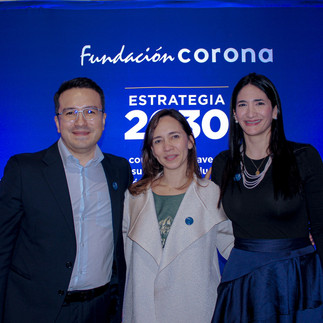
Young people are a decisive part of Colombia’s future. Fundación Corona presents its strategy toward 2030
This foundation, created in 1963, has refocused the strategy it had been implementing for the past 10 years to direct its efforts toward strengthening and transforming the system of actors that generate education, employment, freedom of choice and influence opportunities for youth in Colombia.
Until 2035, young people will represent approximately 45% of the country’s economically active population, yet they currently face significant barriers to entering the labor market; their participation in formal elections and decision‑making structures remains limited, and they show high levels of distrust and dissatisfaction with democracy.
Today, Colombia has 12.5 million young people, and 5.2 million of them (4 out of 10) are Opportunity Youth—young people who are unable to access education or formal employment opportunities (Alliance for Labor Inclusion, 2025).
Bogotá, October 2025.
After 63 years of work in the country and a decade focused on promoting social mobility and equity in Colombia through education, employment, and citizen participation, Fundación Corona introduced a renewed approach that places young people and the system of key actors that generate opportunities for them at the center. With this strategy, which projects a vision toward 2030, the Foundation seeks to serve the actors within this system by recognizing their existing capacities, supporting better coordination, and making the system more visible so that, through changes in practices, beliefs, narratives, and behaviors, it can generate education, employment, freedom of choice and influence opportunities for youth that are relevant, equitable, and truly accessible to young people.
“Envisioning and co‑creating an opportunity system will be our commitment with young people for Colombia. All actors must improve the way we work: adopt more collaborative and adaptive practices, be more effective, and involve young people much more,” said Daniel Uribe, Executive Director of Fundación Corona.

Over the past 10 years, the Foundation has worked with public, private, and community partners to connect upper secondary education with post‑secondary pathways, recognize and promote socioemotional skills, strengthen citizen participation and public leadership, and influence public policy to improve educational and employment trajectories. This learning process led the Foundation to a key conclusion: if Colombia wants to build a more hopeful future, now is the time to act. Amid the significant window of opportunity presented by the demographic dividend, it is essential to create better conditions for young people to fully realize their potential.
In 2024, with the support of Rockefeller Philanthropy Advisors and other partners, the Foundation reviewed its institutional strategy. The analysis was clear: young people carry much of the potential—and the challenges—of national development. Colombia is at a decisive moment—young people represent 23.4% of the population—and to unlock their potential for personal development and the country’s collective progress, it is necessary to strengthen a system of key actors that can expand real opportunities for education, employment, free choice, and advocacy.
“Although we have made progress, it is urgent that we recognize this is the last window of opportunity we have to work for economic growth and the country’s development—and we can only achieve it by including diverse voices, especially those of young people,” Uribe emphasized.

The data confirms this: youth unemployment remains at 17.5%, 2.8 million young people work in the informal sector, and 83.9% of those aged 15–25 do not feel represented by Congress (Latinobarómetro, 2024). In addition, the labor skills gap has reached 66% (ManpowerGroup, 2024), meaning companies are not finding the talent they need in young people, and average Saber 11 scores increased by only three points between 2018 and 2024.
Faced with this scenario, the 2030 Strategy seeks to ensure that young people access relevant, sufficient, and equitable opportunities that enable them to lead and choose their individual and collective life projects. The Foundation’s approach will focus on four key areas:
Education opportunities
Aimed at strengthening essential learning in upper secondary education—such as reading, mathematics, and critical thinking—so that young people can make informed decisions about their life trajectories.
Employment opportunities
Focused on creating flexible training alternatives that connect to formal employment and promote the recognition of young talent by companies.
Freedom of choice opportunities
Geared toward guaranteeing that young people can exercise their citizenship autonomously and in an informed manner, choose representatives, and actively participate in decision‑making spaces.
Influence opportunities
Focused on strengthening young people’s participation in shaping and monitoring public policies, promoting dialogue, deliberation, and collaboration with institutions and communities.

Fundación Corona will continue operating as a second‑tier foundation, generating impact in young people’s lives through strategic partnerships and joint work with other initiatives in territories such as Barranquilla and Bogotá. It will also advance the strengthening of the opportunity system, assuming roles co‑designed with key actors to: analyze and understand contexts; generate knowledge and evidence; position agendas and promote collective action; support the design and development of solutions; and strengthen capacities and co‑responsible leadership.
The challenge, according to Fundación Corona, is to build a collaborative ecosystem that recognizes young people as legitimate agents of the country’s economic, social, and democratic development, enabling a collective transition toward a future full of possibility and hope for all.